


Foreign Exchange

Forex ( Foreign Exchange)

The Ultimate Guide to Foreign Exchange: A Beginner’s Journey to Global Currency Trading

In a world increasingly interconnected by technology and trade, foreign exchange (Forex) has emerged as a pivotal component of the global economy. Whether you’re a curious individual looking to explore investment opportunities or a seasoned entrepreneur managing international transactions, understanding the basics of Forex is essential. This guide will walk you through the fundamentals, key strategies, and critical insights to help you navigate the dynamic world of currency trading.

What is Foreign Exchange?

Foreign exchange, often abbreviated as Forex or FX, refers to the marketplace where currencies from different countries are traded. It operates as a decentralized network of banks, financial institutions, corporations, and individual traders. With a daily trading volume exceeding $7 trillion, Forex is the largest financial market in the world.
Unlike stock exchanges, Forex operates 24 hours a day, five days a week, allowing traders across time zones to participate. Its primary purpose is to facilitate international trade and investment by enabling currency conversion. For example, a U.S. company importing goods from Europe will need to convert dollars to euros to complete the transaction.
What is Foreign Exchange?

How Does Forex Trading Work?

Forex trading involves buying one currency while simultaneously selling another, forming a currency pair. Each pair has a base currency (the first listed) and a quote currency (the second listed). For instance, in the EUR/USD pair, the euro is the base currency, and the U.S. dollar is the quote currency.
Key Concepts to Understand:
  1. Exchange Rate: The value of one currency relative to another. For example, if EUR/USD is 1.10, it means 1 euro equals 1.10 U.S. dollars.
  2. Bid and Ask Price:
    • Bid Price: The price at which buyers are willing to purchase a currency.
    • Ask Price: The price at which sellers are willing to sell a currency. The difference between these two prices is known as the spread.
  3. Leverage: A tool that allows traders to control a large position with a relatively small amount of capital. While leverage can amplify profits, it also increases risk.
  4. Pips: A pip is the smallest price movement in a currency pair. For most pairs, one pip equals 0.0001.

Why Trade Forex?

Strategies for Forex Trading

1. High Liquidity:

The Forex market’s immense size ensures that there’s always someone willing to buy or sell, making it easy to enter and exit trades.

2. Accessibility:

With low initial investment requirements and online trading platforms, Forex is accessible to almost anyone with an internet connection.

3. Opportunities for Profit:

Traders can profit from both rising and falling markets by taking long (buy) or short (sell) positions.

4. 24-Hour Market:

Forex’s round-the-clock operation allows traders to participate at their convenience.

1. Day Trading:

Short-term trading where positions are opened and closed within the same day to capitalize on small price movements.

2. Swing Trading:

Medium-term trading that involves holding positions for several days to capture larger price shifts.

3. Scalping:

Ultra-short-term trading focused on making multiple small profits throughout the day.

4. Trend Trading:

Identifying and following the direction of market trends for profit.
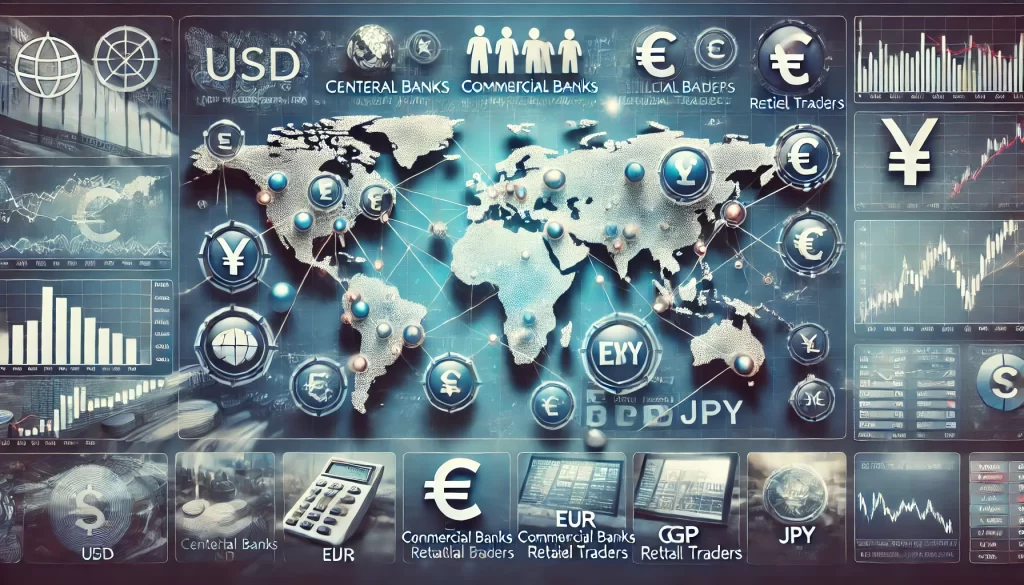
Key Players in the Forex Market

Key Players in the Forex Market
  1. Central Banks: They influence currency values through monetary policies and interventions.
  2. Commercial Banks: Major banks conduct large-scale Forex transactions daily.
  3. Corporations: Businesses engaged in international trade often participate in Forex to hedge against currency risks.
  4. Retail Traders: Individuals trading through brokers constitute a significant portion of the market.

Risk Management in Forex

Tools and Platforms for Forex Trading

Effective risk management is crucial in Forex trading to safeguard your capital and minimize losses. Here are some essential practices:
  1. Set Stop-Loss Orders: Predetermine the maximum loss you’re willing to accept on a trade.
  2. Use Proper Position Sizing: Avoid risking more than 1-2% of your trading capital on a single trade.
  3. Diversify: Spread your investments across different currency pairs to reduce risk.
  4. Avoid Emotional Trading: Stick to your strategy and avoid impulsive decisions driven by fear or greed.
To succeed in Forex, you’ll need reliable tools and platforms. Popular options include:
  1. MetaTrader 4 (MT4): Known for its user-friendly interface and advanced charting tools.
  2. MetaTrader 5 (MT5): An upgraded version of MT4 with additional features.
  3. TradingView: A web-based platform offering advanced charting and analysis tools.
  4. Forex Brokers: Choose a regulated broker with competitive spreads, robust customer support, and a good reputation.

Forex Trading Tips for Beginners

  1. Start with a Demo Account: Practice trading without risking real money to build confidence and skills.
  2. Educate Yourself: Learn the fundamentals, technical analysis, and market dynamics before trading.
  3. Keep Up with News: Economic events and geopolitical developments can impact currency prices significantly.
  4. Be Patient: Consistent profits require discipline and a long-term approach
Forex Trading for Beginner

ConclusionConclusion

Foreign exchange trading offers a world of opportunities for those willing to learn and adapt. While it comes with risks, careful planning, robust strategies, and continuous education can pave the way for success. Whether you aim to diversify your investment portfolio or achieve financial independence, Forex can be a rewarding journey when approached with diligence and discipline.

Take the first step today, and unlock the potential of the world’s largest financial market. Your journey to mastering Forex starts now!